Authored by Justus Eisenbeiss
WTS Tax AG – Director, International Corporate Tax and M&A Tax
This is the latest post in our series on hot topics in German tax law. The series is authored by two German tax experts from our cooperation partner WTS Germany, Gabriele Rautenstrauch (Gabi) and Justus Eisenbeiss, who are currently on secondment in the U.S. Be sure to read our introductory blog post here and our first post on German withholding tax here, or reach out to your GTM contact if you want to connect with Gabi or Justus directly.
The recognition of a German direct tax group (Organschaft) is subject to highly formalistic preconditions that create significant pitfalls for taxpayers. The German Federal Finance Court (Bundesfinanzhof, BFH) recently ruled that a direct tax group is recognized only if claims under the underlying profit and loss transfer agreement (PLTA) are settled in a timely manner, which, according to the court, is generally within 12 months of falling due. Merely recording these amounts on an intercompany account is insufficient. If the deadline is missed, tax group status may be denied for the relevant year or retroactively for all prior years, resulting in each German company being taxed on a stand-alone basis.
We recommend reviewing your German PLTAs and the settlement of PLTA claims for all open tax periods.
Background: What Is a German Direct Tax Group?
Under German tax law, each corporation is generally subject to Corporate Income Tax (Körperschaftsteuer, CIT) and Trade Tax (Gewerbesteuer, TT) on its own income. Dividends paid by a German corporate subsidiary to its German corporate parent are generally subject to dividend withholding tax (WHT) of 26.375%, which the subsidiary must withhold and which the parent can generally credit against its own CIT liability or have refunded. In addition, under the domestic participation exemption, effectively 95% of the dividend is tax-exempt at the level of the parent, and only the remaining 5% of the gross dividend is taxed. At a combined CIT and TT rate of currently approximately 30%, this results in an effective tax burden of roughly 1.5% of the gross dividend.
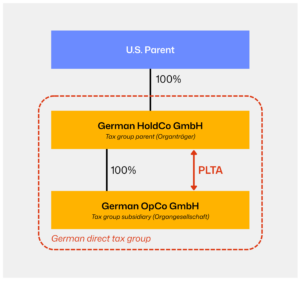
However, where a valid direct tax group exists, the annual profits and losses of the tax group subsidiary (Organgesellschaft) are instead attributed directly to the tax group parent company (Organträger) for CIT and TT purposes. This allows losses of one German company to be offset against profits of another and permits the transfer of profits from the subsidiary to the parent without incurring dividend WHT or the partial taxation under the domestic participation exemption at the level of the parent.
Among other things, a German direct tax group requires that the tax group parent, which can be either a corporation or a partnership (the latter only if it carries on its own commercial business), holds the majority of the voting rights in the tax group subsidiary, which must be a corporate entity. This shareholding must be attributable to a German permanent establishment of the parent. The tax group parent and the tax group subsidiary must conclude a PLTA for a minimum period of five years, according to which the subsidiary must transfer its entire annual profit under its German statutory accounts to the parent, which in turn must compensate any annual loss of the tax group subsidiary. To be recognized for tax purposes, the PLTA must inter alia be “actually implemented” throughout its entire term. The BFH has now specified this requirement in a recent decision.
What Did the Court Decide?
In the decision of November 5, 2025 (I R 37/22, published March 12, 2026), a tax group subsidiary had recorded its profit transfer obligations for 2009 to 2011 as a liability towards its shareholder. However, the amounts were settled only several years later. The BFH denied the recognition of the tax group for these years and confirmed that actually implementing a PLTA involves two elements:
- Recording: The PLTA receivables and payables must be properly recorded in the annual financial statements of the tax group parent and the tax group subsidiary.
- Settlement: The claims must actually be settled in a timely manner (“zeitnah”).
Before the ruling, German tax literature was divided on what constitutes timely settlement, with views ranging from settlement immediately upon the due date to settlement at any time until the tax group ends. According to the BFH, settlement within 12 months after the due date is generally sufficient, which conversely implies that a settlement after 12 months may not suffice.
The BFH further held that settlement requires a cash payment or a set-off with the same effect as a payment (or a similar transaction). Merely booking the claims is not sufficient. A booking on an intercompany current account can in principle qualify. In the case decided, however, only the PLTA claims and interest had accumulated on the account, without counterclaims and without the account being periodically closed and balanced, which under German commercial law is required for the booked claims to be extinguished. The BFH also noted that the claims had not been converted into a loan. Beyond the ruling, the literature generally accepts such a conversion of a profit transfer claim into a loan as a settlement. For loss compensation claims, the permissibility of a conversion into a loan is disputed under German civil law.
When Does the 12-Month Period Start?
The period runs from the due date of the PLTA claim, which the PLTA itself may define. In the case decided, the PLTA provided that the claims fall due upon the formal adoption of the annual accounts. Loss compensation claims fall due at the subsidiary’s fiscal year-end, as confirmed by the German Federal Court of Justice (Bundesgerichtshof). For profit transfer claims, the due date is disputed where the PLTA is silent. The prevailing view points to the date the annual accounts are formally adopted, while some commentators point to the fiscal year-end.
What Is at Stake?
If the PLTA is not actually implemented within the five-year minimum term, e.g., because the claims are not settled within 12 months, the tax group is denied retroactively from the outset. All years are then taxed on a stand-alone basis, losses remain trapped in the company that incurred them, and profit transfers already made are treated as constructive dividends. Like ordinary dividends, these are subject to German WHT of 26.375% (creditable or refundable) and to an effective tax burden of roughly 1.5% under the participation exemption (see above). Loss compensation payments made by the parent are treated as capital contributions to the subsidiary.
If the failure to actually implement the PLTA occurs after the minimum five-year term, at least the affected year is not recognized and, according to the German tax authorities, a new (formally agreed) five-year term is then required for the tax group to be recognized going forward.
The principles of the ruling can be applied to all tax periods that are still open. The Institute of Public Auditors in Germany (Institut der Wirtschaftsprüfer, IDW) has asked the German Federal Ministry of Finance for transitional relief and noted that international groups in particular find it difficult to meet the 12-month period. As of the date of this post, the ruling has not been published in the Federal Tax Gazette (Bundessteuerblatt), which would oblige the German tax authorities to apply its principles in all comparable cases. However, transitional rules as requested by the IDW have also not been issued by the German tax authorities. We expect tax auditors to review PLTA settlements more closely in ongoing and upcoming tax audits.
Recommended Actions
We recommend:
- Reviewing the settlement of PLTA claims for all open tax years.
- Establishing an annual process to settle PLTA claims within 12 months after fiscal year-end, coordinated between German finance and U.S. treasury.
- Documenting all settlements not made by way of actual payment, e.g., set-offs or conversion to loans, in writing and ensuring that intercompany and cash pool accounts are actually balanced.