

As mentioned in our previous post, the Pennsylvania Department of Revenue was reconsidering its guidance regarding §163(j) limitations computed for Pennsylvania purposes. On September 10, 2026, the Department issued Corporation Tax Bulletin 2026-01.
Corporation Tax Bulletin 2026-01 reiterates many existing Pennsylvania policies related to §163(j) without any modifications (e.g., proration of the limitation for interest expense subject to the related-party expense add-back). However, Pennsylvania has reversed its policy of requiring a separate company limitation for members of a federal consolidated group only if the consolidated group itself is subject to a §163(j) limitation. For tax years beginning on or after January 1, 2025, taxpayers must calculate their federal interest
expense deduction on a pro forma basis utilizing §163(j) in effect on December 31, 2024. The separate entity calculation is required even if the taxpayer’s federal consolidated group is not subject to a limitation.
Note that the policy change applies only to tax years beginning on or after January 1, 2025. The policy established in Corporation Tax Bulletin 2019-03 continues to apply to earlier tax years.
________________________________________________
After filling up on lobster rolls during our journey through New England along I-95, we head into the Big Apple for this week’s installment of the One Big Beautiful Bill Act (OB3) road trip. Our stops this week include New York City, New York State, and New Jersey, each with its own twists, turns, and conformity surprises.
New York State
New York State’s budget process was long and winding, but the final bill was passed and signed by the Governor in late May 2026. Most of the conformity (or nonconformity) provisions proposed in the draft budget were retained in the final version.
R&E Expenditures
New York State will decouple from most OB3 provisions related to R&E expenditures. The primary exception is the small business transition rule, which allows small businesses to amend their 2022-2024 New York State returns to claim refunds for the full deduction of their R&E expenditures. New York State will not adopt the federal acceleration rules under Sec. 70302(f)(2), the full expensing of R&E under IRC §174A, or OB3’s revised amortization rules for foreign R&E under IRC §174. Taxpayers must add back any federal deductions taken under these provisions. R&E expenditures from 2022-2024 must continue to be amortized under TCJA rules, with a subtraction allowed for the TCJA-based amortization amount. For 2025 and later, New York will allow a subtraction for domestic and foreign R&E expenditures as if the taxpayer had elected amortization under IRC §174A(c). This treatment shortens the amortization period for foreign R&E from 15 years to as little as 5 years. Additional guidance is needed on how New York State will apply IRC §174A(c), particularly regarding the benefit-realization rule that determines when amortization begins.
Bonus Depreciation
New York State has long decoupled from bonus depreciation under IRC §168(k), and that position remains unchanged. The state will also decouple from OB3’s new bonus depreciation rules for qualified production property under IRC §168(n). Taxpayers must add back any bonus depreciation claimed under §168(n) and compute the depreciation deduction as if no IRC §168(n) election had been made.
New York City
The New York State budget bill also updated New York City’s tax code, and several key differences between the state and the city will increase compliance complexity for taxpayers filing in both jurisdictions.
163(j) Business Interest Limitation
New York State will conform to OB3’s revised IRC §163(j) calculation, and return EBITDA for ATI. New York City, however, has decoupled from this change and will continue to apply the pre-OB3 §163(j) rules, using EBIT for ATI.
R&E Expenditures
The differences become even more pronounced in the city’s treatment of R&E expenditures. New York City will (surprisingly) conform to the federal transition rules under Sec. 70302(f) of PL 119-21. As a result, both the retroactive deduction for small businesses and the accelerated deduction of unamortized R&E for all taxpayers will be available for New York City purposes. Unlike New York State, which decouples from OB3’s foreign R&E rules, New York City will conform to IRC §174. No city-level modifications are required for foreign R&E. For tax years beginning on or after January 1, 2025, New York City will not allow full expensing of domestic R&E under IRC §174A. Instead, domestic R&E must be amortized over 5 years using the mid-year convention.
179 Expensing & Bonus Depreciation
Another key difference involves the increased §179 deduction limits introduced in OB3. While New York State has conformed to the increased deduction limits, taxpayers must add back the deduction for city purposes and compute the IRC §179 deduction under pre-OB3 rules.
The one area where New York State and New York City align is bonus depreciation. Both jurisdictions continue to decouple from IRC §168(k) and will also decouple from OB3’s new bonus provisions under IRC §168(n).
New Jersey
With the New Jersey legislative session ending on June 30, 2026, and no OB3-related legislation enacted, the state’s conformity posture remains unchanged. New Jersey’s guidance issued in late 2025 therefore remains the primary source of direction for corporate taxpayers navigating OB3’s impact.
163(j) Business Interest Limitation
New Jersey conforms to the business interest expense limitation under IRC §163(j) as provided in the TCJA and the CARES Act. This treatment will not change under OB3. New Jersey will continue to conform to IRC §163(j) to the extent federal rules remain consistent with the New Jersey Corporation Business Tax Act.
R&E Expenditures
In November 2025, New Jersey issued guidance on the treatment of R&E expenditures. The guidance focused primarily on determining when “qualified research expenses” used for the New Jersey research credit become deductible. It also included a chart outlining various scenarios. The key takeaway is that New Jersey will follow the federal treatment of R&E expenditures as revised by OB3. Absent legislative changes, New Jersey will conform to the immediate expensing of domestic R&E under IRC §174A and the amortization of foreign R&E under IRC §174.
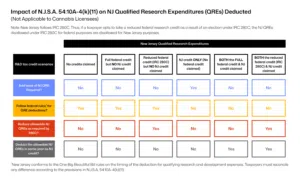
Source: State of New Jersey, 1996- 2026 Department of the Treasury Division of Taxation
Bonus Depreciation
To date, New Jersey has not issued guidance specifically addressing bonus depreciation under OB3. New Jersey already decouples from all versions of bonus depreciation under §168(k), so OB3’s return to 100% bonus depreciation will not apply. Additional guidance would be helpful to confirm New Jersey’s treatment of IRC §168(n). However, NJRS Sec. 54:10A-4(k)(12)(A) requires that depreciation for property acquired after September 10, 2001, be determined based on the IRC in effect on December 31, 2001. This requirement effectively causes New Jersey to decouple from §168(n), including bonus depreciation for qualified production property.