
*Originally published in the May/June/July 2026 edition of The Ohio Society of CPAs’ CPA Voice publication. View here.
The 2026 tax filing season is fully underway. Ohio CPAs were able to file many calendar-year-end income tax returns before the original deadline in April, but they will do a significant amount of work this summer and fall to prepare and file returns extended this spring. For tax practitioners, this season has involved navigating technical issues while managing continued tax uncertainty.
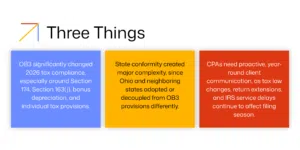
The spring tax season also reinforced the importance of proactive tax planning and year-round communication with clients. The following trends have been especially important to Ohio CPAs this spring.
One Big Beautiful Bill Act
The enactment of the One Big Beautiful Bill Act, or OB3, on July 4, 2025, has heavily shaped tax compliance for taxpayers and practitioners this year. The legislation included changes to corporate, pass-through, and individual taxation. OB3 modified many Internal Revenue Code rules, including the qualified business income deduction, Section 199A; the taxation of overtime wages and tips; and various corporate provisions, including the foreign-derived deduction eligible income deduction, Section 250. The items with the broadest applicability for businesses and individuals are outlined below.
- IRC Section 174 research expenditures: OB3 addressed the mandatory capitalization and amortization rules under IRC Section 174. The legislation generally restored more favorable treatment for domestic research expenditures by allowing taxpayers greater flexibility to deduct qualifying costs currently rather than amortizing them over extended recovery periods. For many businesses, this change has resulted in a significant cash-tax savings opportunity. Corporate taxpayers have had to consider the interaction between Section 174 rules and other laws to manage their effective tax rate. These considerations often led to scenario modeling and planning involving accounting-method considerations, tax elections, and amended returns.
- IRC Section 163(j): OB3 modified the business-interest-expense limitation rules under IRC Section 163(j), significantly affecting taxpayers with debt. The revised rules permanently restored the EBITDA method for calculating the business-interest-expense limitation. For many businesses, these changes reduced taxable income and decreased federal and state cash taxes.
- Bonus depreciation: The OB3 legislation enhanced bonus depreciation, allowing taxpayers to accelerate deductions for relevant expenditures. This created immediate cash-flow benefits for capital-intensive taxpayers and increased refund opportunities in many cases. OB3 introduced IRC Section 168(n), which allows a 100% bonus-depreciation deduction for qualified production property placed in service in the United States, benefiting certain manufacturers and producers looking to expand their domestic operations.
- Tax Cuts and Jobs Act extensions: OB3 permanently extended the Tax Cuts and Jobs Act individual income tax rates, the increased standard deduction, and the repeal of personal exemptions.
- SALT cap increase: The state and local tax deduction limitation was increased from $10,000 to $40,000, giving many taxpayers an additional tax-savings opportunity. This was particularly helpful in high-tax states.
- Charitable contribution deduction changes: OB3 modified the rules for charitable contribution deductions for both individuals and corporations. Starting in tax year 2026, the charitable deduction for individual taxpayers who itemize will be subject to additional limitations. Taxpayers who claim the standard deduction also may claim a larger deduction for qualifying charitable cash contributions. Additionally, the corporate charitable tax deduction is now subject to a 1% floor. Many CPAs began working with clients in 2025 to optimize the tax benefit of charitable contributions given these rule changes.
Tax Savings
Some Ohio CPAs report an anecdotal decrease in their clients’ 2025 cash-tax liabilities and corresponding increases in taxpayer refunds. This observation is supported by data published by the Internal Revenue Service. Many of these refunds were likely triggered by OB3 provisions affecting business deductions and individual tax benefits. However, these observations will need to be confirmed by the IRS after reviewing final return data.
Tax Return Extensions
Many taxpayers chose to extend their 2025 tax returns because they needed more time to gather filing data. Ohio CPAs reported delays in the delivery of brokerage Form 1099 data as one contributing factor. The uncertainty and nuance surrounding OB3 provisions also were an issue. These extensions led to many client conversations in which CPAs reassured clients that filing an extension is common and appropriate when more time is needed to file accurately.
Continued IRS Service Challenges
The IRS published favorable electronic filing and refund processing results. However, Ohio tax practitioners continued to experience delays resolving tax notices and connecting with service agents when calling IRS service centers. Staffing reductions and resource constraints at the IRS may have contributed to slower response times for high-touch issues. Tax scams also prompt taxpayer inquiries and telephone calls, which slow response times for general matters.
State Conformity
One of the more burdensome challenges of the 2026 filing season is state conformity with OB3. Rolling conformity states, such as Colorado, Illinois, and New York, automatically incorporated OB3 provisions as federal law changed. However, some of these states subsequently decoupled from specific OB3 provisions, particularly bonus depreciation and Section 174, creating additional complexity for multistate taxpayers. Below, we summarize guidance from Ohio and certain neighboring states on major provisions in OB3.
- Ohio: Ohio enacted legislation conforming to the Internal Revenue Code as of March 5, 2026, incorporating OB3 provisions. While Ohio does conform to the new bonus depreciation for qualified production property under Section 168(n), the state remains decoupled from bonus depreciation under Section 168(k) and the increased Section 179 deduction limits. Taxpayers are required to add back these amounts claimed for federal tax purposes, but they may deduct them gradually on their Ohio returns over a period of years. Additionally, taxpayers with tax years ending after March 7, 2025, and before March 5, 2026, may irrevocably elect to apply OB3 provisions either on 2025 returns or on 2026 returns.
- Michigan: Michigan enacted several decoupling provisions in response to OB3. The state updated its Internal Revenue Code conformity date to Jan. 1, 2025, but simultaneously decoupled from several major federal provisions, including portions of bonus depreciation and research expenditure changes. Michigan will continue to decouple from IRC Section 168(k), will decouple from IRC Section 168(n), and will follow the Tax Cuts and Jobs Act version of IRC Section 179. It will continue to conform to the pre-OB3 treatment of IRC Section 174 amortization and will apply IRC Section 163(j) limitations using prior adjusted taxable income calculations.
- Pennsylvania: Pennsylvania enacted selective decoupling provisions from several OB3 corporate tax changes for CNIT purposes. The state will require taxpayers to amortize research and experimentation expenditures, both domestic and foreign, over five years. This approach effectively extends the recovery period for most pre-2025 domestic research and experimentation expenditures while simultaneously accelerating the recovery for foreign research and experimentation expenditures. Pennsylvania also decoupled from the federal provision allowing immediate expensing of certain qualified production property, instead requiring taxpayers to apply standard depreciation rules applicable to real property. In addition, Pennsylvania will continue applying the IRC Section 163(j) business-interest-expense limitation rules as they existed on Dec. 31, 2024. Pennsylvania legislation surrounding OB3 will require companies to unwind federal benefits and apply more complex state-specific computations.
Final Thoughts
The first part of tax season demonstrated how quickly federal tax legislation can reshape the tax landscape for both taxpayers and practitioners. For CPAs, the spring reinforced that state conformity analysis is more critical than ever and that multistate tax computations are becoming increasingly complex. The most important takeaway for CPAs is a simple reminder: Clients rely on us for proactive planning and year-round communication amid legislative uncertainty and regulatory change.